A Foodies Fantasy in Seoul, Korea by Jaclyn Sison

We lead our travel journeys with our stomachs, and then our hearts

  Living in Seoul, knowing that there is over 80,000 restaurants here per the World Cities Culture Forum in 2016, you can only imagine how much time we spend looking for the best ones to eat at.  In our little piece of Seoul, we have managed to find six restaurants that we visit frequently.  I wish I knew where all of the photos were saved so I could show you how good the food looked! But you’ll just have to trust me when I say that I highly recommend these restaurants!

Stacked (Gangnam)

  This place was in such a prime location if you knew where the Yongsan base was in Seoul.  Before Yongsan closed down, this restaurant was located right outside of the walk-in gate by Itaewon. Right before we left Korea, we found out it moved to Gangnam. I was pretty sad because Sean and I ate here and we made it our “go-to” when we wouldn’t know where to eat.  We usually spend roughly about $50 here when we go, and we would get four sets of dumplings, two orders of fried rice, and drinks.  It’s such a steal for good dumplings!

Ichiryu. Photo from ViaMichelin.Co.Uk

Ichiryu. Photo from ViaMichelin.Co.Uk

Ichiryu (Itaewon)

  44 Jandari-ro 3an-gil, Mapo-gu, Seoul, South Korea | We found this restaurant by luck.  We were exploring the back streets of Itaewon where there is less traffic, and we noticed the Michelin recommended sign on the window.  When we entered, it was just a small bar.  They serve dinner menus here, and it’s three choices of Sapporo style lamb.  We ordered a French rack and lamb chops.  They prepared it for us, and it was absolutely delicious.  It’s a little on the pricier side for the amount of food you get, so we’d recommend saving for the occasion.

BBQ Chicken (Yongsan)

  If you didn’t already know, Koreans are well known for their BBQ and their fried chicken.  BBQ Chicken was a staple food in our household.  We ordered BBQ chicken almost every weekend when Sean came home.  There’s just something about those honey glazed wings and that undeniable crispy freshness the chicken had.  What blew our minds was the chicken would still be crispy (after heating in the oven) the next day! Witchcraft we tell you!  Absolutely mind blowing. 5 out of 5 for fried chicken, and I didn’t even eat fried chicken like that before Korea.

MenyaSandaime (Itaewon)

  24 Hongik-ro 5an-gil, Mapo-gu, Seoul, South Korea | We are forever on the search for the best ramen we can find.  Unfortunately, Sean hasn’t been able to taste ramen in Japan yet, but Menya Sandaime has definitely come very close to hitting home.  This ramen shop is quaint, but the line will go passed the neighboring stores.  The ramen noodles are made in house, the broth is super rich and flavorful. We’d recommend the black garlic ramen since it has such a bold flavor.

Egg Drop (Various locations)

  The versatility of eggs is always inspiring to me.  This small café specializes in egg sandwiches.  The menu isn’t very large, but the items are packed with flavor.  We tried three sandwiches in one visit and they did not disappoint.  We recommend this for a quick on-the-go brunch stop as their containers do well to prevent you from getting sandwich droppings on yourself.  If you’re feeling adventurous, try their delicious egg vanilla latte! It’s egg-citingly delicious, no yoke! 

Maple Tree (Itaewon)

116-1, Itaewon-dong, Yongsan-gu, Seoul | It would be a shame to leave Korea without finding some amazing Korean BBQ.  We hadn’t realized how small the restaurant was until we went there trying to get a seat.  Our first recommendation would be to call ahead and try and reserve a space.  Once we were in though, the service was extremely fast.  The menu itself is fairly large, and the quality of meat reflects in the price for sure.  It did not seem like a very large portion of food, but with the unlimited sides, I was surprisingly satisfied for the rest of the night.  The aesthetic of the restaurant was very nice as well, seeing as most of it was covered in empty soju bottles!

Hibarin. Photo from imperialpalaceboutiquehotel.com

Hibarin. Photo from imperialpalaceboutiquehotel.com

Hibarin (Itaewon)

  737-25 Hannam-dong, Yongsan-gu, Seoul, South Korea | This is another Japanese restaurant located in Itaewon. We were lucky to find this place after visiting, Vinyl & Plastic, a record store and cafe. This restaurant is located under IP Boutique hotel. It had a very modern aesthetic to it so dining there is very Insta-worthy. The katsu that we ordered was so good! It’s really something you can’t go wrong ordering.

Breastfeeding: Getting comfortable for a pumping session by Jaclyn Sison

Isn’t it such a crazy thought that your body makes the perfect nutrition for your child every day? It still boggles my mind when I think about how my breastmilk changes to fit Maverick’s needs on a daily basis. That’s why I believe that if I can pump milk for him, then I’ll do that. In my previous post, I said “fed is best.” Some moms may have a different opinion on whether [exclusive] pumping is considered breastfeeding, and in my personal opinion, it is. Breastfeeding is hard. Pumping is hard, and it can be discouraging in the beginning if you aren’t getting “enough”. So to try and make your sessions a little more relaxing, make sure your environment is set up so you can just chill for 20-40 minutes while you pump.

My pumping set up

How I started pumping to start building my supply

I started hand expressing as soon as Maverick was born and I tried to get him to latch. When he was admitted to the nursery, I started hand expressing and manually pumping to try and get colostrum for him as supplementation to breastfeeding. In the beginning, Maverick was jaundiced, so we did breastfeeding, expressed milk, and then formula to supplement. You always want to start with breastmilk first if you plan on supplementing with bottle feeds. I wasn’t getting very much out in the beginning, but by day 5 my milk came in. That’s when I started using my Spectra S1.

I would pump about an hour after feeding him or 30 minutes before I knew he was going to wake up again. Luckily Maverick is like clockwork and wakes up at 2 hours on the dot, so it’s been easy to guesstimate when would want to feed. I wouldn’t get very much in the beginning when I’d pump. I’d actually get more from my letdown in the Haakaa. But the more I pumped, the more I got. I’ve learned that my biggest supply comes early in the morning around the 0600-0700 feeding. That’s because Prolactin is highest throughout the night, which is what stimulates milk production. So in the morning before I start pumping, I make sure that I have everything I need so I don’t have to get up or be interrupted.

Related Reads:

> What is hyperbilirubinemia?

> Our breastfeeding journey

Setting the scene for your session

First off, you want to make sure you’re comfortable where you’re pumping. Whether it’s in your glider, on your couch, or cuddled in your bed. If you’ve got a pump that can’t be wireless, then this is even more important. I’ve found that when I’m uncomfortable on my couch because I sink into the crevices, I stop my session a lot sooner. Have your blanket and pillows if you need them, and adjust yourself so your legs aren’t asleep by the time your session is over.

If you’re like me, then you know nursing and pumping make you a savage hungry beast, also a dehydrated one. It’s so important to stay hydrated if you’re breastfeeding or pumping, and it’s also very important to maintain the appropriate amount of calories. I know a lot of women postpartum want to get back to that “pre-pregnancy” body quickly, but don’t let your focus on losing weight effect your supply. So choose a water source that helps you easily keep track of how much water you’re drinking, and have nutritious snacks that help with milk supply. I’ve tried Munchkin’s Lactation Cookies and Milky Mama’s Emergency Brownies. I noticed an increase in my milk supply when I was eating them, but it is important to be aware of how much sugar you’re taking in when you indulge in these treats. I’ve also made lactation cookies! I’ll post the recipe in another blog soon!

My favorite glider for breastfeeding

Now that you’ve got your environment set and your snackies on the side, let the pumping commence! The first night I tried pumping at home was awful. Not only was it in the middle of the night, but I didn’t have a hands-free pumping bra. Trying to hold two flanges up to your tatas when you’re half asleep is ROUGH. I invested in a Lansinoh bra and 3 Kindred Bravely bras. The Lansinoh bra is great if you’re just going to pump, otherwise it’s very difficult going back and forth between a nursing bra and that bra. The Kindred Bravely bras are worth the money though! There are two clips: one for pumping and one for nursing. So it makes it very easy if your little one is attached to you during a pump session.

Before you attach those flanges to you, make sure you have some lubies for your boobies. I hadn’t realized that pumping can be super uncomfortable after a few sessions and nursing in-between. To prevent chafed or cracked nipples, slather on some nursing safe lanolin. It helps prevent your nipples from getting sore due to all the suction that goes on. If you’re new to breastfeeding, you might still be getting used to the little one constantly trying to tear your nipple off (I’m 4 weeks in and it’s still a battle), so the lanolin helps heal those small cracks too. The one I use now is from Honest Company! It’s a lot easier to apply than the one I was using from Medela. I find that it glides on a little easier which is nice when your nips are super sensitive.

And lastly, make sure you have something to entertain you for those 20-40 minutes that you’re pumping. Use this time to read a book, catch up on a show, or like me, write a blog. Pumping has become a part of my “me” time, so make the most of it!

Three years into our story: Happy Anniversary to us! by Jaclyn Sison

I can’t believe Sean and I have hit our 3-year mark already! Yesterday we celebrated our proposal anniversary. That’s right, Sean and I got engaged the night before our elopement. I love telling our elopement story because it’s so different from the traditional wedding; it’s so… us. And I love bringing these photos back up because to this day it is still my favorite set of photos. Forever grateful to one of my favorite photographers, Carolina, for capturing our first milestone as a couple.

The first look of a bride and groom

Sean and I met in 2014 after I came back from LDAC. It was unexpected for me to fall so hard for Sean since I had just gotten myself out of a whirlwind of a relationship, and I had just found my footing again being myself. But there was something different about Sean that kept my attention, and it was probably the fact that he and I seemed to be the same person (for the most part, I’m definitely meaner than Sean is). Sean and I dated all throughout college. We were apart for some time because of his career and my school was on the other side of the state. When I graduated from nursing school, my career brought me halfway across the world to Europe. That’s how we found ourselves in Copenhagen, Denmark.

Elopement in Copenhagen

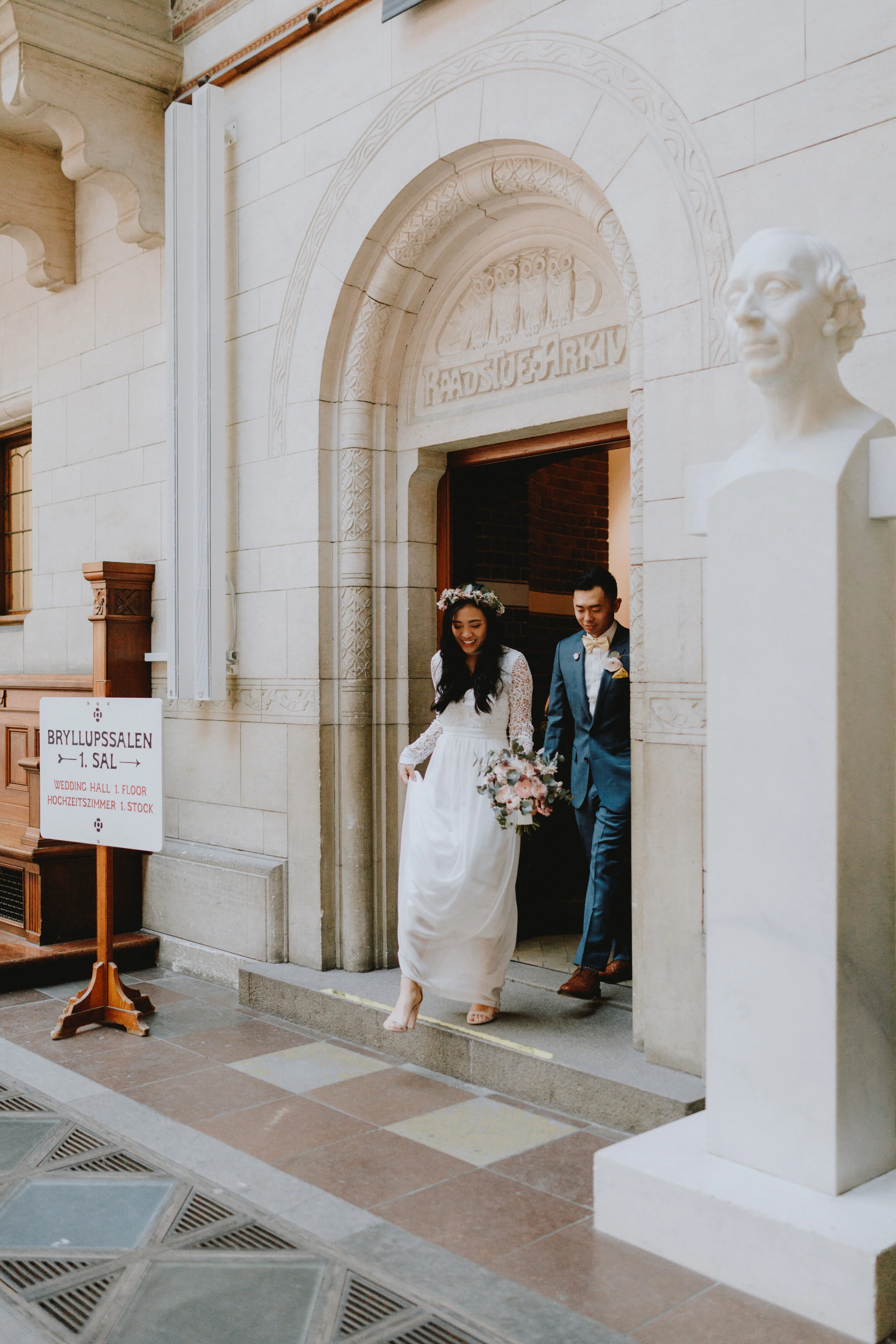
We had a very intimate ceremony at the Bryllupsalen in Copenhagen’s City Hall. It was just us, his parents, sister, and my mom… and my mom’s random friend. If I had to choose to have a traditional wedding, I’d choose a place with the same aesthetic as the Rådhuspladsen. Every moment of our elopement felt like it was in a fairy tale.

Wedding Hall in Copenhagen
Bryllupssallen Kobnhavn

After our ceremony, we walked over to the Botanisk have (Botanical Garden) for our photos. When I saw this place online, I knew that it was where I wanted my photos taken with Sean. It was definitely the best way to capture our fairy tale elopement. What I loved about Copenhagen, is that on the entire walk to the garden, everyone was congratulating us on getting married. So it was like we had a giant wedding party of strangers throughout the entire day.

Botanisk have
J&M_Wedding_Elopement_Copenhagen2017(330of408).jpg

So where are we now?

Sean and I still ended up spending about 1.5 years apart after we got married. When it was time for him to move duty stations, I put in the paperwork to follow. I left my European dream early and moved to Korea. We were still apart in Korea by 4 hours (due to Seoul traffic) but it was better than being a hemisphere away. We were lucky enough to escape Korea, and move to good ole’ Texas together. We aren’t fans of living here, but we’re grateful that we are able to be together especially since we’ve started our little family here.


Dear Babe,

I can’t believe that you and I have made it to three years! It doesn’t feel that long, but it also feels like we’ve been together for so much longer. The past 3 weeks, I’ve loved watching you learn how to be a daddy to Maverick. From the moment that you held him, it’s like we were complete. I know that there have been some trying times we’ve had together, but I’m so glad to know that we work as a team to get through it all. Building our temporary home in Texas has been so much fun, especially since we finally have just one household. This upcoming year is going to be crazy together as we learn our new roles as parents, but I can’t wait to see where it takes us. I love you so much! Maverick and I are lucky to have you in our lives.

Love, Jakki

Breastfeeding: 3 weeks into our journey with Maverick by Jaclyn Sison

Breast is best. That’s what I’ve always learned as a nurse, and that’s what I’ve always believed. There is so much science to support why breast milk has a step up on formula since it’s pretty much an individualized recipe formulated just for your baby and their needs. When I’d give my breastfeeding patients education, everything I was saying seemed so easy to do. I wasn’t naive. I knew before having Maverick that breastfeeding was challenging for any mom, whether it was their first kid or their fifth kid. And after three weeks, I can see why my thoughts on Breast is Best changed to Fed is Best.

White Sands National Monument, New Mexico

White Sands National Monument, New Mexico

In the first week of Maverick’s life, we were still supplementing with formula because of him being jaundiced and my milk not coming in. There were nights where I told Sean to feed the baby formula if I was too tired to get up and breastfeed. Breastfeeding is taxing on your body. Every time I feed I have to eat something or I get dizzy. After feeds, I’m hit with such a hard headache that I have to take a gram of Tylenol every 8 hours just to be able to function or even sleep. And it seems like no matter how much water I drink (almost 96 ounces) a day I still feel dehydrated.

Week two came, and my milk finally came in (it sounds like it’s a package you’re anxiously waiting for from Amazon Prime…) I go back to working 12-hour shifts after maternity leave and I’m nervous about what it’s going to do to my supply especially when I’m more tired, more stressed, and more active. I’ve heard many women say that when they go back to work and when they start working out again that they notice a major drop in their supply. I’ve made it a priority to try and pump at least twice a day now. So far, I’ve been pretty lucky to stash 1-2 pouches in the freezer for my lil’ stash but I’ve noticed that my sleep takes a toll on my supply. Then there was a few days where I was taking antihistamines for PUPPPs and my supply dipped. Thankfully it came back when I stopped taking the meds.

Museum of Agriculture, El Paso, Texas during the poppy season

Museum of Agriculture, El Paso, Texas during the poppy season

It’s been a rocky road

This journey has brought on many sleepless nights. Maverick likes to feed every 2-3 hours. It becomes tiring when 30 minutes of that is spent feeding him and another 20 minutes trying to put him down to sleep. It’s been hard on Sean and I because I become very frustrated at night when it’s hard to console Maverick after feeding. I’ve read so many stories from women who say trying to breastfeed made them feel so bad that it lead to PPD (postpartum depression). This worries me a lot since I already receive mental health treatment. And last night, my son broke me. For the past three weeks we’ve been running low on energy and last night I hit a wall. At 3 AM when my son wouldn’t fall asleep, I gave in and gave him to Sean. I didn’t ask for help, I gave up and made Sean take over. I cried myself to sleep because I didn’t know what else to do and I could feel my patience slipping. The last thing I want to do is let it get too far where I start to resent breastfeeding Maverick.

I’m really hoping that we can find our groove together as a unit so we can avoid that. It’s still a learning process for all of us, so if you have any recommendations or suggestions, we’re very open to them. We’re new to all of this. No matter how many babies I’ve taken care of at work, I definitely was not prepared to be a mom.

Hyperbilirubinemia: My baby is yellow and it's not because he's Asian! by Jaclyn Sison

You should’ve seen the unease in our pediatrician’s face when they told us Maverick’s bilirubin levels went down, and we said, “oh so he’s just yellow because he’s Asian then.” We never fail to make people feel uneasy with our Asian jokes. But with all of that aside, the word hyperbilirubinemia can already be scary to someone who can barely break it down to pronounce it correctly. So I’ll try to do a quick breakdown on what it is.

Disclaimer: The content on my website is not intended to be a substitute for professional medical advice, diagnosis, or treatment. Always seek the advice of your physician or other qualified health providers with any questions you may have regarding a medical condition. Never disregard professional medical advice or delay in seeking it because of something you have read on this website.

Neonatal phototherapy

A tough time trying to be the mom and not the nurse of Maverick

Maverick had to be under the phototherapy lights for 2 nights. The first night we had him back in our room was extremely difficult on me and Sean. We were up every 2 hours to go to the NICU and feed Maverick on the first night and we were up the entire first day after delivery. We were extremely excited to have him in the room with us, but he was not excited about the phototherapy lights. I thought I would do okay with this since I’ve helped treat so many “bili-babies” as a nurse, but I was so wrong. The emotional attachment that I had as a mother was hard to overcome. Every time Maverick started crying, my first instinct was to take him out. It was extremely hard to not soothe my baby. When I would breastfeed him, I’d still hold the bili-blanket underneath him, but even that irritated him.

His level at initial testing was 11.4, and after one night of therapy it went down to 11.3. Not much progress was made and that was probably due to the fact that breastfeeding was new to us both, and because we kept pulling him out from the lights. We opted to put him back in the NICU for phototherapy hoping that a more controlled environment would help him get better. His levels did go up to 15 the second day, but since he was getting older, the threshold for therapy went up as well. It wasn’t enough to keep him admitted for phototherapy, so we changed the treatment to breastfeeding with formula supplementation and was seen the next day as an outpatient. When we came back, his level dropped a little bit, and we decided to treat his tongue tie by having the pediatrician do a frenulectomy. After a few days of great breastfeeding sessions, formula, and sunbathing, we noticed his jaundice start to go down. At his first well-child check up, they drew labs and said the would call us if his levels were abnormal. It’s been a week since the lab was drawn and we’ve heard nothing back, so it looks like we’re in the clear!

What is hyperbilirubinemia, and is it normal in babies?

So let’s just break down the word: Hyper as in excess of; bilirubin as in the compound that is made due to the breakdown of RBCs (red blood cells); and -emia as in the suffix that refers to something to do with blood. So basically, there is an excess of the remnants of broken down blood cells circulating in babe’s blood. It isn’t uncommon that a baby will be slightly jaundiced after birth. The reason that babies appear yellow when jaundiced is because bilirubin is pigmented yellow!

When a baby is in utero, the placenta works hard at removing bilirubin from the baby’s bloodstream. After delivery, the baby’s liver takes over and sometimes needs a little time to catch up. Don’t be surprised if your baby is more jaundiced after a more traumatic delivery that causes bruising or a hematoma. There is a certain level that babies have to reach to receive phototherapy, so not all jaundiced babies need to be put under lights.

Breastfeeding jaundiced baby

How is hyperbilirubinemia tested and treated?

So this is where nursing comes in! Aside from physical assessment of the skin every shift, at the 24-hour mark, every newborn is screened. This screening includes things like hearing screen, congenital heart disease test, PKU (phenylketonuria) screening, and a TcB test. TcB stands for Transcutaneous Bilirubin. This is done with a device that is pressed against the newborn’s forehead and takes a reading of how much bilirubin is detected through the skin. If the levels are above the facility's recommended threshold level, that’s when the nurse will draw a TSB, or Total Serum Bilirubin. This is done with w a heel stick and drawn in a pediatric blood tube.

American Academy of Pediatrics

American Academy of Pediatrics

The American Academy of Pediatrics has a chart showing the serum level vs neonatal age and what the risk zones for treatment are. If the TSB levels are high enough then phototherapy will be started. If they are considered low-risk, encouragement of breastfeeding with supplementation of formula may be recommended. This is because bilirubin is excreted in stool and urine. This could be another reason why it is more common for exclusively breastfed babies to become jaundiced after birth. It can be the learning curve that momma and baby have as they begin their breastfeeding journey and waiting for mommy’s milk to come in. So if your baby does require more than just frequent breastfeeding sessions and supplementation, your pediatrician will go over what phototherapy is.

Infant foot

What is phototherapy? Can it be dangerous?

The risk of putting your baby under phototherapy lights is pretty low. Proper precautions are taken to monitor the baby’s well-being under the lights, such as an eyemask, continuous temperature monitoring, and a new one I’ve seen, continuous pulse ox. Phototherapy lights are blue spectrum lights that mimic what the sun would do for Baby. It helps breakdown the bilirubin through the skin, which will come out in Baby’s diaper as soiled diapers. Most facilities have triple light therapy which just means in addition to the two lights that are placed above Baby, a special blue light fiber-optic blanket will be placed under Baby. Baby will only be wearing a diaper while receiving light therapy to maximize skin exposure. This is why it is important to monitor Baby’s temperature to make sure that it isn’t too hot or too cold under the lights. I hadn’t seen continuous pulse ox monitoring until Maverick received phototherapy. They told me it was because they wanted to make sure they could see his oxygenation was normal since the blue lights could cause him to be mistaken for cyanosis. I didn’t think it made any sense, so I just appreciated the continuous pulse ox since he had been admitted to the NICU for oxygen therapy. Good thing I’m a nurse, right?

So if it’s so common, why should we be worried about jaundice in a newborn?

Though most of the time jaundice in newborns an be harmless, the reason to treat aggressively is to prevent any brain damage. When severe jaundice is left untreated, the excess bilirubin can cause seizures and brain damage. Kernicterus is the name of the disease when bilirubin levels reach too high of a limit and cause this brain damage. Signs and symptoms of kernicterus include drowsiness, fatigue, fever, uncontrollable or high-pitched crying, trouble feeding, fever, abnormal muscle tone/spasms, and abnormal eye movement.

So if you are concerned that your newborn could be developing jaundice after you have been discharged from the hospital, make sure that you bring it up at the first well-child check up, or sooner if you’ve got a few days before.